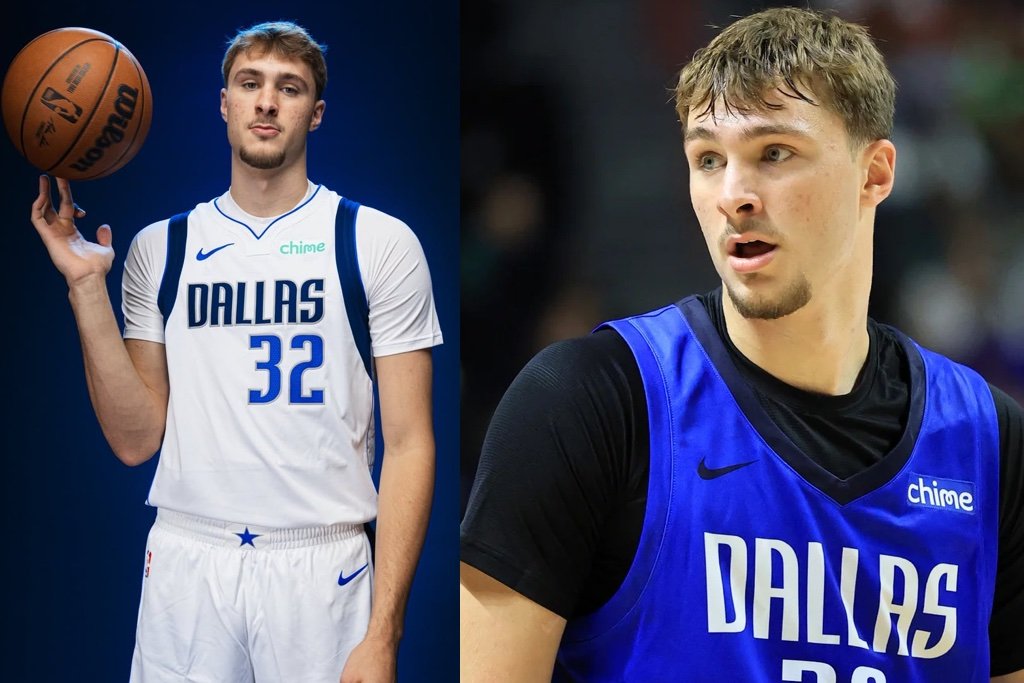
How a kid from a town of 3,000 in Newport, Maine became the NBA’s No. 1 pick and put together one of the most decorated rookie seasons since Michael Jordan.
The small-town prodigy who arrived ahead of schedule
The simplest measure of how good Cooper Flagg’s first NBA season was: he became the first rookie since Michael Jordan in 1984-85 to lead his team in points, rebounds, assists and steals. The 19-year-old also became the first 18-year-old in league history to score 40 points, then went back-to-back with 40+, something no rookie had done since Allen Iverson in 1996-97. For a player drafted No. 1 overall amid enormous hype, the remarkable thing is that he somehow exceeded it.
What makes the story better than a stat sheet is where he came from. Flagg isn’t the product of a basketball metropolis or an overseas academy — he’s a kid from Newport, Maine, a town of roughly 3,000 people, who got to the NBA a full year early by sheer force of being too good to wait. In an era when many of the league’s top young talents are developed abroad, Flagg is widely considered the best American prospect since Anthony Davis or Zion Williamson, and he’s done it carrying an entire state’s pride with him.
Quick facts
| Full name | Cooper Flagg |
| Born | December 21, 2006, Newport, Maine |
| Age | 19 |
| Height / wingspan | 6’8″ with a 7-foot wingspan |
| Position | Forward |
| Team | Dallas Mavericks (No. 32) |
| Draft | No. 1 overall, 2025 NBA Draft |
| College | Duke (one season) |
| Parents | Ralph and Kelly Flagg (both former college players) |
| Twin brother | Ace Flagg (plays for the University of Maine) |
| 2025-26 honors | NBA Rookie of the Year, All-Rookie First Team |
| Rookie averages | 21.0 points, 6.7 rebounds, 4.5 assists |
A basketball family in the middle of Maine
Flagg was born December 21, 2006, in Newport, Maine, about 25 miles west of Bangor, into a family where basketball wasn’t a hobby so much as a way of life. Both his parents played college basketball: his mother, Kelly, was a three-time conference champion and team captain at the University of Maine, and went on to coach high school ball; his father, Ralph, also played in college. Kelly has joked that her sons had basketball-shaped teething rings.
That upbringing produced a houseful of competitors. Cooper has a fraternal twin brother, Ace — born one minute earlier — who is now a forward at the University of Maine, and an older brother, Hunter, who also plays. The family’s story carries a quiet grief as well: Hunter’s twin, Ryder, was born prematurely in 2004 and died two days later. The surviving brothers grew up battling in the driveway, where, as Ace told a local outlet, “We couldn’t play a game in our driveway without someone bleeding.”
The Maine connection is central to how Flagg is perceived. As a freshman at Nokomis Regional High School, he and Ace led the boys’ team to its first-ever state championship. When he reached Duke and the NBA spotlight, the whole state rallied behind him. “It’s such a cool feeling knowing that I have the whole state behind me,” he told NBC News, “and it’s kind of history that I’m being able to do.”
Montverde, Duke, and a year-early gamble
Flagg’s talent quickly outgrew Maine. He and Ace transferred from Nokomis to Montverde Academy, the Florida basketball powerhouse, where Cooper led the program to a national title. Then came the decision that defined his trajectory: he reclassified from the 2025 high school class up to 2024, accelerating his timeline by a full year so he could play at Duke in 2024-25 — and become eligible for the 2025 NBA Draft a year ahead of schedule.
It paid off spectacularly. In his lone college season, Flagg averaged 19.2 points, 7.5 rebounds and 4.2 assists, and swept the sport’s top individual honors, winning both the Naismith and John R. Wooden awards as the best player in college basketball. He was the eighth Duke player to win the Wooden Award. The one blemish was a team one: heavily favored to win the NCAA tournament, Duke lost in the Final Four, though Flagg himself was excellent in the defeat with 27 points, 7 rebounds, 4 assists, 3 blocks and 2 steals.
In April 2025 he declared for the draft, and the Dallas Mavericks — having won a chaotic draft lottery — selected him first overall.
Walking into a franchise in turmoil
Flagg arrived in Dallas under unusual pressure. The Mavericks had stunned the basketball world the previous season by trading franchise icon Luka Dončić to the Lakers for Anthony Davis, leaving a fan base furious and a roster in flux. Into that turmoil walked an 18-year-old expected to be the future of the franchise — and, with veteran guard Kyrie Irving sidelined to begin the season, he was even asked to handle some point-guard duties out of the gate.
He responded by becoming the face of the team almost immediately. He won back-to-back Rookie of the Month awards and built a historic campaign that ranks among the best teenage seasons the league has seen. The standout stretch came late in the year: a 51-point game against the Orlando Magic that made him the first teenager ever to score 50, followed two nights later by a 45-point, 9-assist, 8-rebound performance in a win over the Lakers — a night that ended the Mavericks’ longest home losing streak in 32 years and featured a postgame embrace with LeBron James.
Flagg stayed characteristically level about it. “I think it’s definitely some sort of statement,” he told ESPN, “but it just goes back to what I said: I’m confident in myself, and I know what I’m capable of. I’ll just let the rest of the stuff figure itself out.”
A historic Rookie of the Year race
Flagg finished his debut season averaging 21.0 points, 6.7 rebounds and 4.5 assists, and was named the 2025-26 Kia NBA Rookie of the Year, earning the Wilt Chamberlain Trophy and a spot on the All-Rookie First Team. In doing so he became the third Maverick to win the award, joining Jason Kidd — now his head coach — and Luka Dončić.
The race itself was notable. Flagg edged his former Duke teammate Kon Knueppel, who’d had a strong season in Charlotte, by just 26 points in the voting — the second-smallest margin since the current format began in 2002-03. The two finished first and second in rookie scoring, the first former college teammates to do so since UConn’s Emeka Okafor and Ben Gordon in 2004-05. Tellingly, the friends said they never discussed the award all year. “Me and Kon, we talked all year long,” Flagg said. “We never talked about the Rookie of the Year or what people were saying about it.”
His one significant setback was a late-season left ankle injury, but it didn’t dent the broader picture: despite a difficult year for the Mavericks as a team, who missed the playoffs, Flagg’s individual brilliance carried the season’s narrative.
Conclusion
Cooper Flagg’s first year delivered on a level of hype that usually crushes teenagers. The historic firsts — the first 18-year-old to hit 40, the first rookie since Jordan to lead his team in four major categories — aren’t just trivia; they’re evidence that the gamble of reclassifying and arriving early was justified many times over. He didn’t need a runway. He was ready.
The interesting question now is how high the ceiling actually is. He’s a 6’8″ forward with a 7-foot wingspan who can shore up his weaknesses — his three-point shooting (29.5%) is the obvious area to grow — while already doing nearly everything else at a star level. If the jumper develops, the comparisons to the best American prospects of the last decade may end up looking conservative. For a kid from a Maine town of 3,000 who carried a whole state to the league, the most remarkable thing about Cooper Flagg may be that he’s only just getting started.