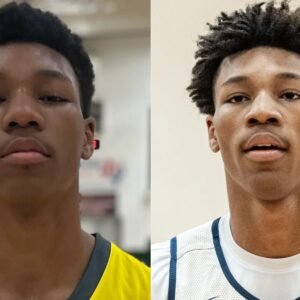
How Arafan Diane went from buying a soccer ball in Guinea to becoming the No. 1 center recruit of 2026 — a McDonald’s All-American headed to Houston, in just a few years.
Table of Contents
The accidental basketball prodigy
Arafan Diane’s path to the top of American basketball recruiting began with a soccer ball — one he never bought. As a 12-year-old in Guinea, towering over everyone around him, Diane went to a local market for a soccer ball and instead caught the eye of Souleymane Kasse, a coach with Guinea’s national training center. Struck by the kid’s extraordinary height, Kasse told him to buy a basketball instead. A decade later, that chance encounter has produced the No. 1 center prospect in the 2026 class, a McDonald’s All-American committed to the University of Houston.
What makes Diane remarkable isn’t just the origin story — it’s how compressed his development was. He didn’t grow up with the sport. He learned it as a teenager, in a second language, on a second continent, after a political coup delayed his journey by two years. By the time he reached American prep basketball, he’d barely been playing organized games. That he became “arguably the most physically dominant player in the country” in that span is the kind of trajectory that genuinely defies the usual recruiting script.
Quick facts
| Full name | Arafan Diane |
| Class | 2026 |
| Position | Center |
| Height / weight | 7’1″, around 260–290 lbs |
| Wingspan | 7’4″ |
| Origin | Guinea, West Africa |
| Path | Guinea → Montreal, Canada → Des Moines, Iowa |
| Prep school | Iowa United Prep (Norwalk, Iowa) |
| Nickname | “Baby Shaq” |
| Ranking | Five-star; No. 1–2 center; around No. 21–23 overall |
| Committed | Houston (announced Nov. 19, 2025 — his birthday) |
| Honor | McDonald’s All-American |
From Guinea to Montreal to Iowa
Diane’s basketball education was anything but conventional. After being discovered in that Guinean market, his progress was immediately complicated by circumstances far beyond a teenager’s control. He spent time working around a coup d’état in his home country, then waited roughly two years without playing a single organized game before he could relocate to Canada to pursue the sport seriously.
The language barrier was its own obstacle. “You can’t play basketball when you’re not speaking English,” Diane recalled of his early days in Montreal. He developed within Canadian basketball programs, eventually joining the system that gave him his first true organized competition. Ahead of his junior season, his program relocated to Des Moines, Iowa, becoming Iowa United Prep — and that move gave the big man his first real taste of U.S. basketball.
The personal toll of that journey shaped his mindset. “I need to come in with a good mentality because you don’t have a mom [in America], you don’t have any dad, you don’t have nothing,” he told HoopsHQ. “You need a strong mentality.” For a young player navigating multiple countries, languages and a brand-new sport largely on his own, that self-reliance became as defining as his size.
A physically dominant big man
By every account, Diane’s most striking attribute is his sheer physical presence. He stands 7-foot-1 with a 7-foot-4 wingspan and a frame listed anywhere from 260 to nearly 300 pounds — dimensions that earned him the “Baby Shaq” nickname from scouts and media. As 247Sports’ Adam Finkelstein put it, “Diane is arguably the most physically dominant big man in the national class… big and powerful from head to toe with tree trunk legs.”
But the scouting reports stress he’s more than just a giant. Finkelstein praised his powerful dunks, good hands and — surprisingly for a player his size — real shooting touch, noting he hit 5 of 9 from three in Adidas 3SSB play. His production backs it up: Diane led the 3SSB circuit in rebounding at 10.8 boards per game while averaging 18.6 points and shooting better than 74% from the field. He saved his best for the 3SSB Palmetto Road Championships, posting 21.6 points, 13.0 rebounds, 3.2 assists and 1.8 blocks across five games.
That assist number hints at something beyond brute force. Profiles describe a center with a genuine desire to find open teammates, and Diane has said he aims to emulate Nikola Jokić’s playmaking style — even as his size invites the more obvious Joel Embiid comparisons. Asked whether he’s a good passer, he answered with characteristic confidence: “I don’t like talking about myself too much.”
The recruitment and Houston commitment
Diane’s combination of size, production and remarkable backstory made him one of the most pursued bigs in the country. He accumulated around two dozen high-major offers — from Kansas, UConn, Indiana, Kentucky, Louisville, Florida, Oregon and many others — before narrowing his list. His final group reportedly included Arkansas, Indiana, Houston, Kentucky and Virginia.
On November 19, 2025 — his birthday — Diane committed to Kelvin Sampson and the University of Houston, choosing the program that, in his telling, simply outworked everyone. “He and his staff recruited me hard,” Diane said of Sampson. “I spoke with Coach Sampson every Sunday and he texted me after games. They have been to my school many times and that meant a lot to me. The fans and the facility are great, too.” The consistency of that personal contact clearly resonated with a player whose journey had taught him to value people who show up reliably.
It’s a natural fit on the court, too. Houston under Sampson has built its identity on toughness, rebounding and physical defense — exactly the traits Diane embodies. A dominant, high-motor center who leads circuits in rebounding is precisely the kind of player who thrives in that system.
Conclusion
Arafan Diane is the rare prospect whose story would be compelling even without the basketball. A kid spotted by chance in a Guinean market, who navigated a coup, a language barrier and three countries to teach himself the game as a teenager, becoming a McDonald’s All-American and the No. 1 center in his class — it’s a journey that puts the usual recruiting hype in perspective.
The basketball questions are real but encouraging. He’s still relatively new to the sport, which cuts both ways: it means his polish and feel are less refined than peers who’ve played their whole lives, but it also means his ceiling may be far higher, with the steepest part of his learning curve still ahead. The physical tools are undeniable, the rebounding and rim protection translate immediately, and the flashes of shooting and passing suggest a more complete game than his size alone implies. At Houston, in a program built for exactly his strengths, Diane has a chance to develop into an NBA center. For someone who picked up a basketball almost by accident not many years ago, simply reaching this point is extraordinary — and his story may only be getting started.