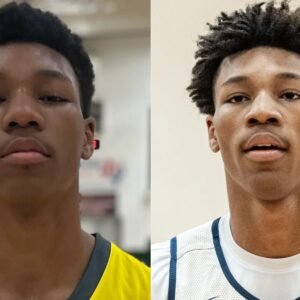
How Bryson Howard — son of NBA All-Star Josh Howard — went from unranked to a five-star Duke signee in a single year, and why his late-blooming rise makes him so intriguing.
Table of Contents
The late bloomer who exploded into a five-star
Most elite recruits are flagged years in advance, their every game tracked since middle school. Bryson Howard’s rise was the opposite — and that’s what makes him fascinating. As recently as his junior year, the 6-foot-5 wing from Frisco, Texas was unranked. Then a single grassroots season changed everything: he rocketed from outside the top 60 to No. 12 in the country, collected offers from nearly every blue-blood program, and in October 2025 committed to Duke. Few prospects have climbed that far that fast.
The other half of his story is in the name. Howard is the son of Josh Howard, the former NBA All-Star, Wake Forest legend and ACC Player of the Year. That pedigree gives him a built-in basketball IQ and a famous comparison point — but the more interesting truth is that Bryson didn’t ride his father’s name to stardom. He was an afterthought in the rankings until his own play forced the basketball world to catch up.
Quick facts
| Full name | Bryson Howard |
| Class | 2026 |
| Position | Wing / small forward |
| Height / weight | 6’5″, around 200 lbs |
| Wingspan | 6’11” |
| Hometown | Frisco, Texas |
| High school | Heritage High School |
| AAU | Pro Skills (Nike EYBL) |
| Ranking | Five-star; around No. 12 nationally; No. 1 in Texas |
| Committed / signed | Duke (committed Oct. 21, 2025; signed Nov. 2025) |
| Other finalists | North Carolina, Kentucky |
| Father | Josh Howard, former NBA All-Star (Dallas Mavericks) |
A basketball bloodline from Texas
Howard hails from Frisco, Texas, and plays for Heritage High School, but his basketball roots run through North Carolina. His father, Josh Howard, was a star at Wake Forest who won ACC Player of the Year before the Dallas Mavericks drafted him 29th overall in the iconic 2003 NBA Draft — the class that produced LeBron James, Carmelo Anthony, Dwyane Wade and Chris Bosh. Josh played 10 NBA seasons and made the All-Star team in 2006-07.
That heritage clearly shaped Bryson, and he’s spoken about North Carolina feeling like a second home because of his father’s ties there — a connection that made his recruitment, and his eventual choice, all the more intriguing. But the key point about Howard’s development is that the pedigree didn’t translate into early hype. He came up under the radar, which makes his subsequent explosion onto the national scene all the more impressive.
The rise: from unranked to top 12
Howard’s ascent is one of the more dramatic recruiting stories of the 2026 cycle. He was a relative unknown until he caught fire on the grassroots circuit following his junior season at Heritage. Playing for Pro Skills on the Nike EYBL circuit in spring 2025, he averaged 20.9 points and 5.6 rebounds while shooting 52.8% overall and a scorching 45.5% from three — production that forced evaluators to take notice.
The rankings scrambled to keep up. In one notable update, Howard leapt 32 spots — from around No. 60 to No. 28 — and the offers poured in. Within a single week in June 2025, he picked up offers from Duke, Michigan, Oregon and Maryland, adding to a list that eventually included Kentucky, UConn, Houston, Tennessee, Texas, Memphis and his father’s alma mater, Wake Forest. By the time his recruitment peaked, he’d reached five-star status, climbing all the way to No. 12 nationally and the No. 1 prospect in Texas.
That trajectory — a meteoric, late-blooming rise rather than years of steady hype — is genuinely uncommon among top prospects, and it speaks to a player whose game developed rapidly and whose ceiling may still be rising.
The scouting profile
What evaluators like about Howard is a combination of physical tools and a translatable skill set. 247Sports director of scouting Adam Finkelstein described him as “an athletic southpaw wing with good positional size, a high-motor, and terrific frame that is undoubtedly going to continue filling out.” The left-handed wing “attacks the rim in straight lines, getting downhill and absorbing contact with a physical style,” rises up to finish above the rim, and is a lob threat.
The detail that excites scouts most is his shooting. Finkelstein noted Howard “has a translatable shooting stroke and has even shown some flashes of being able to make movement shots” — citing 45% from three and 75% from the free-throw line, numbers he called “very unusual for someone so young” and with such length (a 6-foot-11 wingspan). Combined with engaged defense, good court coverage and solid playmaking metrics, the profile is that of a modern two-way wing with room to grow — especially given his frame is still filling out and he won’t turn 18 until after his high school graduation.
Choosing Duke and “The Brotherhood”
Howard’s recruitment came down to a blue-blood trio: Duke, North Carolina and Kentucky. He took official visits to all three before announcing his decision live on the CBS Sports College Basketball Channel in October 2025, becoming Jon Scheyer’s first commitment in Duke’s 2026 class.
His reasoning blended culture, relationships and that North Carolina connection. “I liked The Brotherhood,” Howard said of Duke. “I liked Jon Scheyer and Chris Carrawell and how they made me feel at home. The state of North Carolina is like my second home, so it would feel good to be back.” He pointed to a personal touch that stood out — an outdoor hibachi dinner at Scheyer’s house — as part of what sealed it. “I spent a lot of time with the coaches and players… and it felt like home,” he told ESPN.
The commitment fit Scheyer’s blueprint. Duke has landed the No. 1 recruiting class in consecutive cycles by building around elite freshmen rather than the transfer portal, and Howard became a cornerstone of another loaded haul that grew to include top prospects like Cameron Williams. Given his shooting and versatility, evaluators expect Howard to have a chance to contribute right away in Durham.
Conclusion
Bryson Howard is an unusually compelling prospect because his story runs counter to the usual script. He’s a famous son who wasn’t handed his ranking, a late bloomer who climbed from anonymity to five-star status on the strength of his own play, and a two-way wing whose best basketball may still be ahead given how recently his game came together.
The questions facing him are the standard ones for any recruit — whether the EYBL production translates to the ACC, whether the shooting holds up against elite defenders, whether the still-developing frame fills out as projected. But there’s reason for optimism in the very thing that defines him: a player who improved this dramatically, this quickly, has shown a capacity for growth that bodes well at the next level. At Duke, under a program built on developing freshmen into pros, Howard has landed in an ideal spot to keep rising. For a kid who was unranked not long ago, the trajectory points firmly upward — and the name that opened doors may end up being the least interesting thing about him.