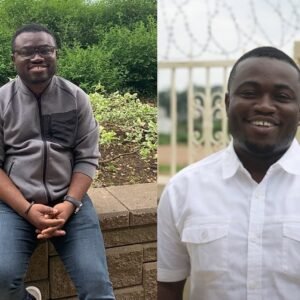
How a near-fatal childbirth experience and a dying mother in a Kano village led Temie Giwa-Tubosun to build LifeBank, the company delivering blood and oxygen across Africa by bike, boat and drone.
Table of Contents
The entrepreneur who turned a personal tragedy into a lifeline
Most healthcare startups begin with a market opportunity. Temie Giwa-Tubosun’s began with a death she couldn’t forget. As a young intern in northeastern Nigeria, she watched a pregnant woman in a Kano village bleed to death over several days from birth complications while her community simply waited for the end — a death that a routine caesarean and a blood transfusion would have prevented, had either been available or affordable. Years later, the difficult birth of her own son drove the lesson home. Out of those two experiences came LifeBank, the data-driven medical distribution company she founded to fix one of African healthcare’s most lethal and overlooked failures: getting blood and oxygen to patients in time.
What makes Giwa-Tubosun compelling isn’t just the mission — it’s the insight behind it. She recognized that Nigeria’s blood crisis wasn’t primarily about a shortage of donors or doctors, but about a broken supply chain: blood existed, hospitals needed it, and there was no efficient system connecting the two. By treating a health emergency as a logistics problem, she built a model that has saved thousands of lives and drawn praise from figures as varied as Mark Zuckerberg and Jack Ma.
Quick facts
| Full name | Oluwaloni Olamide Giwa (now Temie Giwa-Tubosun) |
| Born | December 1985, Ila Orangun, Osun State, Nigeria |
| Age | 40 |
| Nationality | Nigerian-American |
| Education | Minnesota State University Moorhead; Middlebury Institute of International Studies |
| Early career | Global Health Corps fellow; Clinton Health Access Initiative; WHO |
| Company | LifeBank (founded 2016; preceded by the One Percent Project, 2012) |
| Company reach | Operations across Nigeria, Kenya and Ethiopia |
| Husband | Kola Tubosun, linguist (married 2009) |
| Major awards | Jack Ma Africa Netpreneur Prize (2019); Global Citizen Prize (2020); Cartier Women’s Initiative; WEF Social Innovator |
From Osun State to a global health education
Temie Giwa-Tubosun was born Oluwaloni Olamide Giwa in December 1985 in Ila Orangun, Osun State, Nigeria, the fourth of six children, to a university professor and a schoolteacher. Her nickname “Temie” comes from a shortening of one of her birth names, Temitope. Growing up partly in Nigeria and later moving to the United States gave her an early, firsthand view of the stark contrast between healthcare systems — the gaps in access, infrastructure and emergency care that would later define her life’s work.
She pursued her undergraduate studies at Minnesota State University Moorhead and later earned a graduate degree at the Middlebury Institute of International Studies in California, with a focus on public service and global systems. Her academic interest in governance and how policy shapes everyday lives translated directly into a career in global health rather than conventional business.
Before founding her own company, she built serious credentials in the field. She was a 2011–2012 fellow with the Global Health Corps — a program she credits with building the confidence and networks she’d need to scale her later impact — and worked with major organizations including the Clinton Health Access Initiative and the World Health Organization. Through this work she gained a crucial insight that would become the foundation of LifeBank: in many low-resource settings, the problem isn’t a lack of medical expertise, but the inability to get critical supplies where they’re needed fast enough.
The experiences that sparked a mission
Two moments crystallized Giwa-Tubosun’s path. The first came during a 2003 internship with the UK’s Department for International Development in northeastern Nigeria, when she and her team encountered the dying pregnant woman in Kano. The helplessness of that scene — a preventable death for want of basic, accessible care — lodged itself in her and pushed her to study health systems in developing countries.
The second was deeply personal: the birth of her first child, which came with serious complications of its own. Having nearly experienced the same kind of maternal emergency she’d witnessed in others, the abstract policy problem became viscerally real. The combination of professional knowledge and personal stakes is what turned a concerned health worker into a determined entrepreneur.
She started with advocacy. In 2012, she founded a non-governmental organization called the One Percent Project (formally the One Percent Blood Donation Enlightenment Foundation), aimed at ending blood shortages by educating Nigerians about donation and overcoming the myths, fears and apathy surrounding it. It was effective at raising awareness but revealed a harder truth — awareness alone couldn’t fix a broken distribution system. That realization set the stage for LifeBank.
Building LifeBank
In January 2016, Giwa-Tubosun founded LifeBank in Lagos, incubated at the Co-Creation Hub in Yaba. The premise was elegantly simple and genuinely novel: use data, technology and logistics to discover available blood across the country and deliver it quickly to the hospitals and patients who needed it. LifeBank has been described as the first fully digital blood bank of its kind, connecting registered blood banks to hospitals in real time.
The operational model is where the company’s ingenuity shows. LifeBank dispatches blood and supplies in WHO-compliant cold-chain boxes using whatever transport the terrain demands — confronting the famous gridlock of cities like Lagos and Nairobi with bikes, boats and, in hard-to-reach or dangerous areas, drones. As Giwa-Tubosun explained, drones aren’t used for everything, but for specific cases “where the patient doesn’t have a lot of time to live” or where bandits make roads impassable. It’s technology deployed in service of a clear human need, not for its own sake.
The company expanded its offerings beyond blood. In 2018 it launched AirBank to deliver emergency medical oxygen, and later added StockBank, which uses collective bargaining and prediction technology to distribute PPE and consumables. Within roughly five years, LifeBank grew from a single Nigerian operation into a pan-African company with operations across Nigeria, Kenya and Ethiopia — and a stated vision of becoming “the supply chain engine for healthcare systems across Africa.”
A defining moment of validation came early. When Mark Zuckerberg visited Nigeria in 2016, he met Giwa-Tubosun and said of LifeBank: “If she actually pulls it off, then she’d show a model that will impact not just Lagos, not just Nigeria, but countries all around the world.” It was a heady endorsement that raised expectations — and one she has largely lived up to.
The COVID-19 pivot
The COVID-19 pandemic became both a crisis and a proving ground for LifeBank’s model. With its existing oxygen-delivery infrastructure through AirBank, the company was unusually well positioned to respond. It moved over 1,000 oxygen cylinders to isolation centers and hospitals treating COVID-19 patients, and partnered with government agencies and the Nigerian Institute of Medical Research to launch free drive-through mobile testing centers in Lagos and Oyo State.
This pandemic response significantly raised Giwa-Tubosun’s international profile and demonstrated that LifeBank’s infrastructure could flex to meet emergencies beyond its original blood-delivery focus. It was a vivid illustration of why building resilient medical supply chains matters — and it directly contributed to the wave of global recognition that followed.
Recognition and awards
Giwa-Tubosun’s work has earned an extraordinary collection of honors that track her rise from promising innovator to globally recognized leader. She was named one of six World Economic Forum innovators in 2017, and in 2019 she won the inaugural grand prize of Jack Ma’s Africa Netpreneur Prize Initiative (Africa’s Business Heroes), taking home $250,000 to expand LifeBank across the continent.
The recognition accelerated. In 2020 she received the Global Citizen Prize for Business Leader, specifically for LifeBank’s blood-shortage work and its COVID-19 response. She was named a Cartier Women’s Initiative Laureate for Sub-Saharan Africa, later winning first place in the program’s impact awards, and earned a Forbes Woman Africa Award for Technology and Innovation, an MIT Solve Initiative Award, and recognition as a New African Woman of the Year. In 2024 she added the World Economic Forum Social Innovator Award. Beyond the trophies, the metrics tell the story: LifeBank has reported transporting tens of thousands of medical products, serving hundreds of hospitals, and saving thousands of lives.
Personal life
Giwa-Tubosun is married to Kola Tubosun, a well-known Nigerian linguist and scholar, whom she wed in 2009, and the couple has a son — the child whose difficult birth helped inspire LifeBank. She is known for a disciplined, demanding routine, reportedly rising before 5 a.m., reflecting the focused, determined character she uses to describe herself. Alongside her entrepreneurial work, she has been a consistent advocate for healthcare access and women’s empowerment, themes that run directly from her own near-miss with maternal mortality.
Conclusion
Temie Giwa-Tubosun’s significance lies in a reframing that sounds obvious only in hindsight: that Africa’s medical emergencies are often logistics emergencies. By attacking the supply-chain failures behind blood and oxygen shortages — rather than treating them as inevitable features of under-resourced systems — she built a company that has measurably saved lives and offered a replicable model for the rest of the continent and beyond, just as Zuckerberg predicted.
The questions ahead are about scale and durability. Her stated ambition — to save the lives of a million Africans over a decade and become the supply-chain backbone for healthcare across the continent — is enormous, and expanding a logistics-intensive health business across multiple countries with different infrastructures, regulations and funding environments is genuinely hard. Whether LifeBank can grow that far while maintaining the reliability that makes it trusted in life-or-death moments will determine her ultimate legacy. But the foundation is rare and real: a business built not on a market gap spotted in a spreadsheet, but on a death she witnessed and a brush with one of her own. For a woman who turned the worst moments she’d seen into a system that prevents them for others, the impact is already profound — and, by her own design, far from finished.