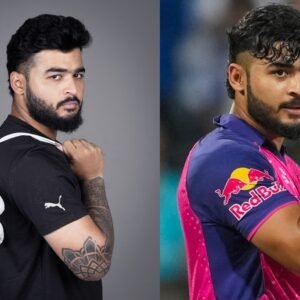
How a farmer’s son from Bihar became the youngest IPL centurion at 14 and the youngest Orange Cap winner at 15 — built on a father who sold his land and a family that rebuilt its life around him.
Table of Contents
The 15-year-old rewriting cricket’s record books
There has never been anything quite like Vaibhav Suryavanshi. At 14, he became the youngest player ever to appear in the Indian Premier League, then days later the youngest centurion in the history of the competition, smashing 101 off 38 balls. At 15, he went further still, finishing IPL 2026 as the tournament’s leading run-scorer — the youngest Orange Cap winner ever — with 776 runs at a strike rate above 237. He is, remarkably, the first IPL cricketer born after the league itself was founded in 2008.
The numbers are so absurd that they almost obscure the more interesting story underneath. Suryavanshi is the son of a farmer from one of India’s poorest states, whose family quite literally sold land and dismantled their livelihood to fund a child’s cricketing dream. His rise is a genuine fairy tale — but it also raises a question the sport is only beginning to grapple with: what does it mean to place this much weight, this much money and this much expectation on someone who is still, by any measure, a child?
Quick facts
| Full name | Vaibhav Suryavanshi (also spelled Sooryavanshi) |
| Born | March 27, 2011, Tajpur/Motipur, Samastipur district, Bihar |
| Age | 15 |
| Batting | Left-handed (top-order batter) |
| Bowling | Slow left-arm orthodox |
| Domestic team | Bihar (debut 2024) |
| IPL team | Rajasthan Royals (signed 2024 auction, ₹1.1 crore) |
| Childhood coach | Manish Ojha (former Ranji cricketer) |
| Cricket idol | Brian Lara |
| IPL records | Youngest debutant; youngest centurion; youngest Orange Cap winner |
| IPL 2026 | 776 runs; Orange Cap, MVP, Emerging Player, Super Striker, Most Sixes |
| 2026 honour | Player of the Tournament, U19 World Cup (175 off 80 in the final) |
A family that rebuilt its life around one dream
Suryavanshi was born on March 27, 2011, in a village in the Samastipur district of Bihar — a state that, as multiple reports note, is among India’s poorest and has historically been a cricketing backwater, with limited infrastructure and little scouting attention. His family had no formal connection to professional cricket. His father, Sanjeev Suryavanshi, had played only club-level cricket and never reached the professional circuit; the dream that didn’t materialize for the father would be poured entirely into the son.
What the family did next is the moral center of the story. As Vaibhav’s talent emerged at district and youth levels, the Suryavanshis made a choice few families would: they restructured their entire existence around his cricket. His father sold a portion of the family’s ancestral farmland to fund coaching, equipment and travel, and effectively gave up his own livelihood to manage his son’s development full-time. “My small business failed because of my full-time focus on training Vaibhav,” Sanjeev told AFP outside the family’s home — a quiet admission of the price paid.
The logistics alone were punishing. For years, father and son traveled roughly 100 km from their village to Patna, where Vaibhav trained under coach Manish Ojha — a journey of about two and a half hours each way, made every other day. His mother, Aarti, would wake before dawn, around 3 or 4 a.m., to prepare fresh homemade meals for those long training days. The child made sacrifices of his own, too: his coach revealed that Vaibhav gave up favorite foods like pizza and mutton to stay disciplined. This was not a casual pursuit of a hobby. It was a whole family betting everything it had on a boy with a bat.
A prodigy from the very start
Suryavanshi picked up a bat at around age four or five, initially coached by his father, before joining an academy at nine and training under Ojha. The signs were immediate and extraordinary. He made his first-class debut for Bihar in the Ranji Trophy in January 2024 at the age of just 12 — one of the youngest to ever do so — and quickly began stacking up youth records.
The performance that truly announced him came in an India Under-19 four-day match against a touring Australia side in Chennai, where he scored a century off just 58 balls — among the fastest hundreds in youth Test cricket. His age-group dominance only intensified: at the 2025 U19 Asia Cup he scored 261 runs in five matches, including a record 171 against the UAE, and he carried that into the U19 World Cup in early 2026, amassing 439 runs across the tournament and a stunning 175 off 80 balls in the final against England to be named Player of the Tournament as India lifted the title.
A telling detail about his temperament comes from those who coached him. As Ojha put it, what makes Suryavanshi special isn’t just talent but “the ability to execute plans on match days” — the rare gift of turning practice into performance when it counts. He models his game on West Indian legend Brian Lara, and there’s a clean, fearless quality to his stroke play that has drawn comparisons to the greats.
The IPL records that made him famous
In November 2024, at just 13, Suryavanshi became the youngest player ever sold at an IPL auction when Rajasthan Royals secured him for ₹1.1 crore (about $130,500) — three times his base price after a bidding war. The figure was life-changing in rural Bihar, and his father admitted he was “speechless.” Crucially, the Royals offered more than money: the franchise, long a breeding ground for young Indian talent, placed him in an environment mentored by former India captain Rahul Dravid, who had been impressed by Suryavanshi in a trial. “I think he has got some really good skills,” Dravid said. “We thought it might be a good environment for him to grow.”
The growth was explosive. On April 19, 2025, Suryavanshi made his IPL debut against Lucknow Super Giants at 14 years and 23 days — the youngest debutant in league history — and hit the very first ball he faced for six. Nine days later, against Gujarat Titans, he produced one of the most stunning innings the tournament has seen: 101 off 38 balls, reaching his hundred in just 35 deliveries. It made him the youngest centurion in IPL history at 14 years and 32 days, recorded the second-fastest century in IPL history and the fastest ever by an Indian, and featured 11 sixes.
If 2025 was the announcement, 2026 was the coronation. Suryavanshi finished as the tournament’s top run-scorer with 776 runs — a century and five fifties at an average of 48.50 and a strike rate of 237.30 across 15 matches — sweeping five major individual honours: the Orange Cap, Most Valuable Player, Emerging Player, Super Striker and Most Sixes. Along the way, in the Eliminator against Sunrisers Hyderabad, he played what Outlook called “a knock of a lifetime,” smashing 97 off 29 balls with 12 sixes — breaking Chris Gayle’s record for most sixes — and then took the winning catch. Rajasthan ultimately fell in Qualifier 2, but the season belonged unmistakably to a 15-year-old.
The prodigy question
Here is where Suryavanshi’s story becomes genuinely worth thinking about rather than simply celebrating. The temptation — fueled by the records and the highlight reels — is to crown him the next great Indian batter before he can legally drive. But cricket history is littered with teenage phenoms who flamed out under the weight of expectation, and the demands on Suryavanshi are unprecedented: global fame, IPL crowds, social-media scrutiny and a nation’s hopes, all landing on a child whose family has staked everything on him.
To their credit, the people around him seem alert to this. His own public comments mix ambition with notable maturity — “the idea is to follow the process and help the team win,” he has said, while joking about the runs he hoped to score. And Indian cricket appears to be managing his transition deliberately rather than rushing him: after IPL 2026 he was named to the India A squad for an ODI tri-series, described explicitly as part of a “gradual transition,” and he himself has spoken of ambitions in the longer formats, including Test cricket, rather than being defined solely as a T20 six-hitter. Whether that careful handling holds — or whether the commercial gravity of a player this marketable proves impossible to resist — is one of the more important questions hanging over his future.
Conclusion
Vaibhav Suryavanshi is the rarest kind of sports story: one where the on-field feats, however jaw-dropping, are matched by the human drama behind them. A farmer who sold his land, a mother awake before dawn, a five-hour round trip made hundreds of times — these are the foundations beneath the 35-ball centuries and the record-breaking Orange Cap. The achievement is real, and the talent looks generational.
The open questions are the honest ones, and they’re not about ability. Can a 15-year-old sustain this trajectory without burning out? Can he translate T20 fireworks into the Test-match longevity he says he wants? And can the adults around him — franchise, board, family and a cricket-mad nation — protect the childhood of a boy who has already given up so much of it? For now, what’s certain is this: Vaibhav Suryavanshi has done things no cricketer his age has ever done, and his family’s enormous gamble has already paid off in ways that once seemed like fantasy. The rest of the story — the part that determines whether he becomes a legend or a cautionary tale — is still being written, one improbable innings at a time.