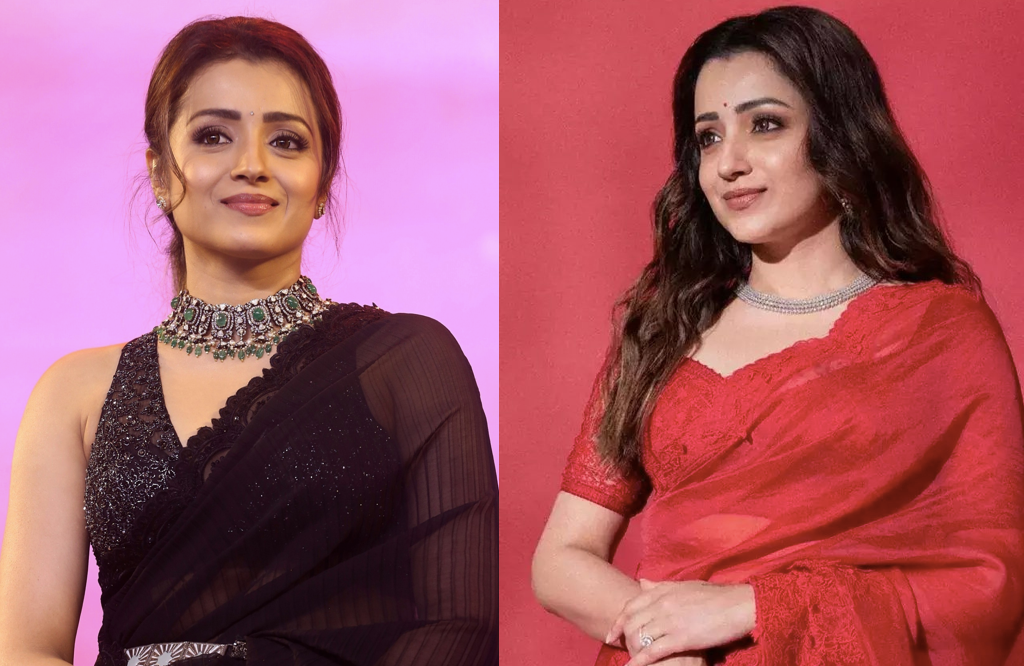
Trisha Krishnan biography — the story of South India’s most enduring leading actress. Discover her age, marriage status, net worth, relationships, career milestones, and life beyond the screen.
Star Facts
- Born May 4, 1983, in Madras (now Chennai), Tamil Nadu, into a Tamil Palakkad Iyer family
- Won Miss Chennai 1999 at the age of 16, which opened the door to her film career
- Also won Miss Salem and the Beautiful Smile award at Miss India 2001
- Widely celebrated as the “Queen of South India”
- The only South Indian actress to sustain a leading role career for over two decades in Tamil cinema
- Aspired to be a criminal psychologist before cinema took over
- Won five Filmfare Awards South, one Tamil Nadu State Film Award, one Nandi Award, and seven SIIMA Awards
- First South Indian actor to receive UNICEF Celebrity Advocate status (2017)
- PETA Goodwill Ambassador for South India
- Fluent in Tamil, English, Hindi, and French
- Unmarried as of 2026; previously engaged to businessman Varun Manian (January–May 2015)
- Estimated net worth: ₹85 crore (~$10 million)
- Father passed away in October 2012; currently lives with her mother and grandmother in Chennai
Who Is Trisha Krishnan?
Trisha Krishnan is an Indian actress, model, and social advocate who has built one of the most durable careers in the history of South Indian cinema. Over more than two decades as a leading actress in Tamil and Telugu films — as well as appearances in Hindi, Kannada, and Malayalam productions — she has remained not only relevant but genuinely bankable, something that very few actresses in any film industry manage across such a span.
Critics call her longevity a rarity. Her peers acknowledge it as a benchmark. Her fans across Tamil Nadu, Andhra Pradesh, and the global South Indian diaspora simply call her Paakkum Thaarame — a timeless vision. The title that has stuck most firmly, though, is the one her industry gave her: the Queen of South India.
Quick Facts: Everything You Need to Know About Trisha Krishnan
| Detail | Information |
|---|---|
| Full Name | Trisha Krishnan |
| Date of Birth | May 4, 1983 |
| Age (2026) | 42 years old |
| Place of Birth | Madras (Chennai), Tamil Nadu, India |
| Nationality | Indian |
| Ethnicity | Tamil Palakkad Iyer |
| Religion | Hinduism |
| Height | 5 feet 4 inches (163 cm) |
| Education | BBA, Ethiraj College for Women, Chennai |
| School | Sacred Heart Matriculation School, Church Park, Chennai |
| Profession | Actress, Model |
| Years Active | 1999–present |
| Debut Film | Jodi (1999) — supporting role |
| Lead Debut | Mounam Pesiyadhe (2002) |
| Languages | Tamil, English, Hindi, French |
| Father | Krishnan (deceased, October 2012) |
| Mother | Uma Krishnan |
| Marital Status | Unmarried |
| Previous Engagement | Varun Manian (engaged Jan 2015; called off May 2015) |
| Net Worth (Est.) | ₹85 crore (~$10 million) |
| Instagram Followers | 8 million+ |
| UNICEF Role | Celebrity Advocate (first South Indian actor, 2017) |
| PETA Role | Goodwill Ambassador, South India |
Early Life & Background: A Chennai Childhood With Global Touches
Trisha Krishnan was born on May 4, 1983, in Madras — the city now known as Chennai — to Krishnan and Uma Krishnan, a Tamil Palakkad Iyer family with deep cultural roots in Tamil Nadu. She is an only child, and the family bond that defines her adult life was shaped early. Her mother, Uma Krishnan, has been her most constant companion throughout her career, accompanying her to film shoots, public events, and industry functions for over two decades.
Her father was posted in New York for a period during her childhood, giving her formative international exposure that would later contribute to her comfort working across different cultural and linguistic contexts. When the family returned to India and settled in Chennai, Trisha entered the social world of one of South India’s most competitive cities — and by her own admission, held her ground rather assertively. She has openly said she used to be a bully in school and that most girls were somewhat wary of her, a confession that sits amusingly alongside her later public image as one of South Indian cinema’s most gracious and composed leading ladies.
As a teenager, her ambitions pointed not toward film but toward criminal psychology — a field she was genuinely drawn to. She has described turning away from that path as a consequence of events rather than a deliberate pivot.
Tragically, her father passed away in October 2012. Trisha has spoken about his loss with evident grief in various interviews, noting that she continues to live with her mother and grandmother in Chennai, maintaining the close family structure that has been the emotional foundation of her career.
Education: From Church Park to Ethiraj College
Trisha completed her schooling at Sacred Heart Matriculation School, Church Park, one of Chennai’s most respected schools, known for academic rigour and a strong tradition of producing accomplished alumni.
She went on to pursue a Bachelor of Business Administration (BBA) at Ethiraj College for Women, Chennai, one of the city’s leading women’s colleges affiliated with the University of Madras. Her time there was compressed and unconventional. Her acting commitments began while she was still enrolled, giving her a tight shooting schedule that made consistent attendance difficult. She managed by attending summer classes to compensate for the academic gaps her film commitments created, eventually completing her degree.
The discipline required to juggle a university programme with the demands of an emerging film career — and do both credibly — revealed something important about how she approaches work: quietly, thoroughly, and without using one to excuse the other.
Career Journey: Two Decades of Leading Lady
Beauty Pageants and the Door That Opened (1999)
Trisha’s entry into the public eye came through the pageant circuit. At the age of sixteen, she won the Miss Salem title and, the same year, the more prominent Miss Chennai 1999 pageant. These wins placed her on the radar of Chennai’s entertainment industry at a moment when she had not yet decided whether she wanted to be there.
She went on to win the Beautiful Smile award at the Femina Miss India 2001 competition — not the main title, but a recognition that sustained her visibility in the modelling world. That same year, she appeared in Falguni Pathak’s music video Meri Chunar Udd Udd Jaye alongside Ayesha Takia, giving her one of the odder early CV entries of any future Tamil star.
The Debut and Early Roles (1999–2002)
Her film career technically began in 1999 with a minor uncredited supporting role — playing Simran’s friend — in the Tamil romantic drama Jodi. It was a blink-and-miss appearance, but it was a beginning.
Her formal lead debut came with director Ameer Sultan’s Mounam Pesiyadhe in 2002, where she starred opposite Suriya. The film was a commercial success and earned her the Filmfare Award for Best Female Debut. Though Lesa Lesa — the Priyadarshan film she had actually signed first — was intended to be her debut, its delayed release meant Mounam Pesiyadhe arrived in cinemas earlier, and the debut honours went accordingly.
Rise to Fame: Saamy, Ghilli and the Big Years (2003–2008)
The mid-2000s were when Trisha Krishnan became a household name across southern India. The films were big, the performances were noticed, and the awards followed in quick succession.
Saamy (2003) cast her as a soft-spoken Brahmin girl, earned wide critical praise, and became a major commercial hit. Ghilli (2004), opposite Vijay, made her one of Tamil cinema’s most beloved leading ladies — her portrayal of Dhanalakshmi, a helpless girl protected by a kabaddi player, became one of her most remembered performances. Ghilli was re-released for its 20th anniversary in 2024 and became one of the highest-grossing re-releases in Indian film history.
In Telugu cinema, Varsham (2004) opposite Prabhas earned her the first of her three consecutive Filmfare Awards for Best Actress — Telugu. Nuvvostanante Nenoddantana (2005) added the second, along with a Nandi Award for Best Actress. Aadavari Matalaku Ardhalu Verule (2007) brought the third.
Among the critical highlights of this period was Abhiyum Naanum (2008), a gentle, emotionally layered father-daughter story in which her performance earned the Tamil Nadu State Film Award and widespread recognition as one of her finest pieces of acting.
Vinnaithaandi Varuvaayaa and Reinvention (2010–2018)
Vinnaithaandi Varuvaayaa (2010), directed by Gautham Vasudev Menon, became a genuine cultural phenomenon in Tamil cinema. The film’s love story, its music by A.R. Rahman, and her performance as Jessie earned her enormous affection and a Filmfare nomination for Best Actress.
She made her Hindi debut with Khatta Meetha (2010) opposite Akshay Kumar, her Kannada debut with Power (2014), and her Malayalam debut with Hey Jude (2018). While none of these crossover films matched the scale of her Tamil and Telugu work, they confirmed her range and her willingness to extend her career into new markets.
’96 (2018) stands as perhaps her most critically acclaimed performance. The film, about two former school sweethearts who meet years later, gave her a role of extraordinary emotional precision. Her performance earned her the Filmfare Award for Best Actress — Tamil, and the film is consistently cited among the finest Tamil productions of the 2010s.
The Mani Ratnam Chapter and Leo (2022–2025)
The period from 2022 onward brought a new dimension to her career — that of a performer trusted with major historical and ensemble productions.
She played Kundavai, the intelligent and politically sharp Chola princess, in Mani Ratnam’s sweeping two-part historical epic Ponniyin Selvan I (2022) and Ponniyin Selvan II (2023). Both films were major critical and commercial events. Her portrayal of Kundavai became one of the most discussed performances of either film.
Leo (2023), an action thriller opposite Vijay directed by Lokesh Kanagaraj, became her highest-grossing release and one of the biggest South Indian films of the year.
In 2024, she expanded into streaming with the crime thriller series Brinda on SonyLIV, playing a police officer with considerable depth and control. Critics were warm about both the show and her contribution to it.
Her 2025 films included Identity (Malayalam), Vidaamuyarchi and Good Bad Ugly (both Tamil, opposite Ajith Kumar), and Thug Life, a gangster drama with Kamal Haasan that underperformed commercially but added to the breadth of her recent portfolio.
Her upcoming film Vishwambhara, opposite Chiranjeevi, is scheduled for 2026.
Career Timeline & Major Milestones
| Year | Milestone |
|---|---|
| 1999 | Won Miss Chennai; minor supporting role in Jodi |
| 2001 | Won Beautiful Smile award at Femina Miss India; appeared in Falguni Pathak’s music video |
| 2002 | Lead debut — Mounam Pesiyadhe; won Filmfare Best Female Debut |
| 2003 | Saamy — critical and commercial success |
| 2004 | Ghilli (Tamil) and Varsham (Telugu) — both major hits; won 1st Filmfare Best Actress — Telugu |
| 2005 | Nuvvostanante Nenoddantana — won 2nd Filmfare Best Actress — Telugu and Nandi Award |
| 2006 | Received Kalaimamani Award; starred in Aaru and Unakkum Enakkum |
| 2007 | Aadavari Matalaku Ardhalu Verule — won 3rd Filmfare Best Actress — Telugu |
| 2008 | Abhiyum Naanum — won Tamil Nadu State Film Award |
| 2010 | Vinnaithaandi Varuvaayaa — cultural phenomenon; Hindi debut with Khatta Meetha |
| 2012 | Father, Krishnan, passes away in October |
| 2014 | Kannada debut with Power |
| 2015 | Yennai Arindhaal; engaged to Varun Manian (Jan); engagement called off (May) |
| 2016 | Kodi — won Filmfare Critics Award for Best Actress — Tamil |
| 2017 | First South Indian actor to receive UNICEF Celebrity Advocate status |
| 2018 | ’96 — won Filmfare Best Actress — Tamil; Malayalam debut with Hey Jude |
| 2022 | Ponniyin Selvan: I as Kundavai |
| 2023 | Ponniyin Selvan: II; Leo becomes her highest-grossing release |
| 2024 | Ghilli re-release becomes one of highest-grossing Indian re-releases; Brinda (streaming debut) |
| 2025 | Identity, Vidaamuyarchi, Good Bad Ugly, Thug Life |
| 2026 | Vishwambhara with Chiranjeevi (upcoming); attended Vijay’s CM oath ceremony |
Key Takeaways
- Trisha Krishnan is the only South Indian actress to have sustained a leading role career for over two consecutive decades in Tamil cinema — a distinction no other actress holds
- Her three consecutive Filmfare Best Actress — Telugu wins between 2004 and 2007 remain one of the most dominant runs in South Indian film awards history
- Her transition from youth-led commercial entertainers to critically acclaimed films like ’96 and Ponniyin Selvan demonstrates deliberate, career-long role selection rather than passive acceptance
- Her streaming debut with Brinda in 2024 confirmed her ability to adapt her screen presence to the intimate demands of episodic television
Is Trisha Krishnan Married? Husband, Relationships & Personal Life
Trisha Krishnan is not married and has no husband as of 2026. She has been consistently single in the years since her only public engagement, and she has not confirmed any current relationship.
Her most publicly acknowledged relationship was with actor Rana Daggubati, with whom she shared a friendship-turned-romance spanning several years during the late 2010s. Rana confirmed the relationship himself on Karan Johar’s Koffee With Karan, saying: “She has been my friend for a decade. We have been friends for a long time and even dated. But, I guess, things didn’t work out.”
On January 23, 2015, Trisha announced her engagement to Varun Manian, a Chennai-based businessman and real estate developer. The announcement was met with widespread excitement from her fanbase. However, by May 2015 — just four months later — she confirmed that the engagement had been called off. She never publicly explained the specific reasons, though reports at the time cited incompatibility and opposition from Varun’s family to the match.
She has been the subject of various other rumoured connections over the years — with actors including Dhanush, Vijay, Simbu, and Prabhas — all of which have remained in the territory of media speculation rather than confirmed fact. Her attendance at Vijay’s Chief Minister oath ceremony in May 2026 reignited online discussion about her connection to the actor-turned-politician, though neither has confirmed anything beyond a longstanding professional relationship.
She currently lives in Chennai with her mother Uma and her grandmother, maintaining the close family arrangement that has defined her personal life for many years.
What Is Trisha Krishnan’s Net Worth?
Trisha Krishnan’s net worth is estimated at approximately ₹85 crore (around $10 million) as of 2026, making her one of the wealthiest actresses in South Indian cinema. Her financial profile is built primarily on her film career, with supplementary income from brand endorsements and real estate holdings.
| Income Stream | Detail |
|---|---|
| Per-film fee | Estimated ₹10–12 crore per major production |
| Brand endorsements | Fanta India, Scooty Pep+, Joy Alukkas, Vivel Di Wills, Volini, Urbanrise; charges ₹35–40 lakh per endorsement |
| Property | ₹10 crore home in Chennai; ₹6 crore property in Hyderabad |
| Vehicles | Mercedes-Benz S-Class, BMW 5 Series, Range Rover Evoque |
| Annual income (est.) | ₹9–12 crore |
| Total net worth (est.) | ₹85 crore (~$10 million) |
These figures are third-party estimates from industry observers and have not been independently verified or confirmed by Trisha or her management.
Philanthropy & Social Work
Trisha Krishnan’s advocacy work runs alongside her film career and reflects consistent, long-term commitments rather than one-off celebrity gestures.
She has been a PETA Goodwill Ambassador for South India for many years, actively campaigning for the adoption of stray dogs, opposing animal cruelty, and encouraging vegetarianism. She follows a vegetarian diet herself. PETA sent her a formal letter of appreciation highlighting her animal rescue work and her influence in encouraging community adoption of Indian dogs.
In 2017, she became the first actor from South India to be conferred UNICEF Celebrity Advocate status, a recognition that came with a specific mandate: to advocate for the rights of children, adolescents, and young people in South India. The role was not ceremonial — she has spoken publicly about child rights at organised events and in media campaigns connected to the UNICEF mandate.
Her philanthropic interests extend to direct community outreach, though she does not publicise the specifics of her charitable activity as extensively as some peers.
Awards & Recognitions
Trisha Krishnan’s award record across two decades reflects consistent recognition from industry bodies and critics alike:
- Filmfare Award for Best Female Debut — Mounam Pesiyadhe (2002)
- Filmfare Award for Best Actress — Telugu (three consecutive wins: Varsham 2004, Nuvvostanante Nenoddantana 2005, Aadavari Matalaku Ardhalu Verule 2007)
- Tamil Nadu State Film Award — Abhiyum Naanum (2008)
- Filmfare Critics Award for Best Actress — Tamil — Kodi (2016)
- Filmfare Award for Best Actress — Tamil — ’96 (2018)
- Kalaimamani Award (2006) — conferred by the Government of Tamil Nadu for contributions to Tamil cinema
- Nandi Award for Best Actress — Nuvvostanante Nenoddantana (2005)
- Seven SIIMA Awards across Tamil and Telugu categories
- UNICEF Celebrity Advocate — first South Indian actor to receive this status (2017)
- ITFA Best New Actress Award — Lesa Lesa (2003)
Controversies & Challenges
Trisha Krishnan’s career has not been free of public controversy, and she has handled the moments that arose with a combination of legal composure and direct public response.
The Suchi Leaks episode in 2017 — a mass leak of alleged private images involving multiple South Indian celebrities — circulated photographs purportedly involving Trisha. She did not issue an extended public statement on the matter, and the images were widely disputed and condemned by digital rights advocates. The incident sparked a broader conversation about the privacy of women in the entertainment industry.
In February 2026, Tamil Nadu BJP state president Nainar Nagendran made a personal remark referencing Trisha while commenting on actor-politician Vijay’s public life. Trisha responded through her legal counsel, issuing a formal statement condemning the remark as “distasteful and inappropriate.” She posted on social media: “Disrespect should and always will be called out.” The episode drew significant attention across Tamil Nadu’s political and entertainment media and was widely seen as a firm and dignified response from someone who had never previously engaged with political commentary.
Interesting Facts About Trisha Krishnan
- She wanted to be a criminal psychologist. Before cinema redirected her path, she had a genuine intention to pursue criminal psychology — a field that, in its own way, she approached with the same analytical interest she brings to complex roles.
- She admitted to being a school bully. In interviews, she has openly acknowledged that she was a dominant and somewhat intimidating presence at school, a confession that surprises many who know only her gracious public persona.
- She speaks four languages fluently — Tamil, English, Hindi, and French — making her one of the most linguistically versatile actresses in South Indian cinema.
- Ghilli was re-released 20 years after its original run and became one of the highest-grossing Indian re-releases ever, confirming that her 2004 films still carry extraordinary audience affection.
- She has a Nemo fish tattoo — a small personal detail that became well-known among her fanbase through social media.
- Her mother Uma has accompanied her to virtually every shoot, event, and function throughout her career — an arrangement so consistent that it has become one of the defining characteristics of how Trisha works.
- She is the only South Indian actress with a sustained leading role career spanning over two decades in Tamil cinema — a distinction no contemporary peer has matched.
- She originally wanted to debut under the name Suhasini, before settling on her birth name for her professional identity.
Conclusion: Two Decades and Still the Queen
What Trisha Krishnan has built over more than two decades in South Indian cinema is not simply a successful career. It is a sustained argument — proved film by film, decade by decade — that a South Indian actress does not have to choose between longevity and quality, between commercial appeal and critical recognition, or between one industry and all the others.
She came to cinema through a beauty pageant, wanting to be a criminal psychologist. She stayed because she found something she was genuinely exceptional at. The Ghilli heroine became the ’96 muse. The pageant winner became a UNICEF advocate. The actress who aspired to be someone else entirely became the one everyone else in her industry aspires to be: still here, still leading, still the Queen.
At 42 years old in 2026, with Vishwambhara ahead of her and a career that shows no sign of slowing, Trisha Krishnan is precisely where the evidence of twenty years of disciplined, intelligent filmmaking says she deserves to be.